




No products in the basket.
Socialisation vs. Training: Why Your Puppy Needs Both
When a new puppy arrives, owners often focus on training. Sit. Stay. Come. Leave it. Please stop eating the skirting board.
These skills matter, but they are only part of raising a dog who can cope with everyday life. Training teaches a puppy what to do. Socialisation helps shape how they feel about the world around them. A puppy may perform a perfect sit in the kitchen and still be terrified of traffic, strangers or the veterinary clinic. Another puppy may happily explore new environments but have no idea how to walk on a loose lead or come back when called.
A puppy needs both emotional confidence and practical skills.
What is puppy training?
Training is the process of teaching behaviours and helping a puppy understand which actions are likely to produce a useful or rewarding outcome.
It includes familiar cues such as:
- sit
- lie down
- come when called
- leave it
- drop
- wait
- walk on a loose lead
But good puppy training is much broader than teaching formal commands.
It also includes:
- toilet training
- settling calmly
- accepting a harness
- travelling safely
- giving up objects
- tolerating gentle handling
- learning to be alone for short periods
- choosing appropriate alternatives to biting, jumping or chasing
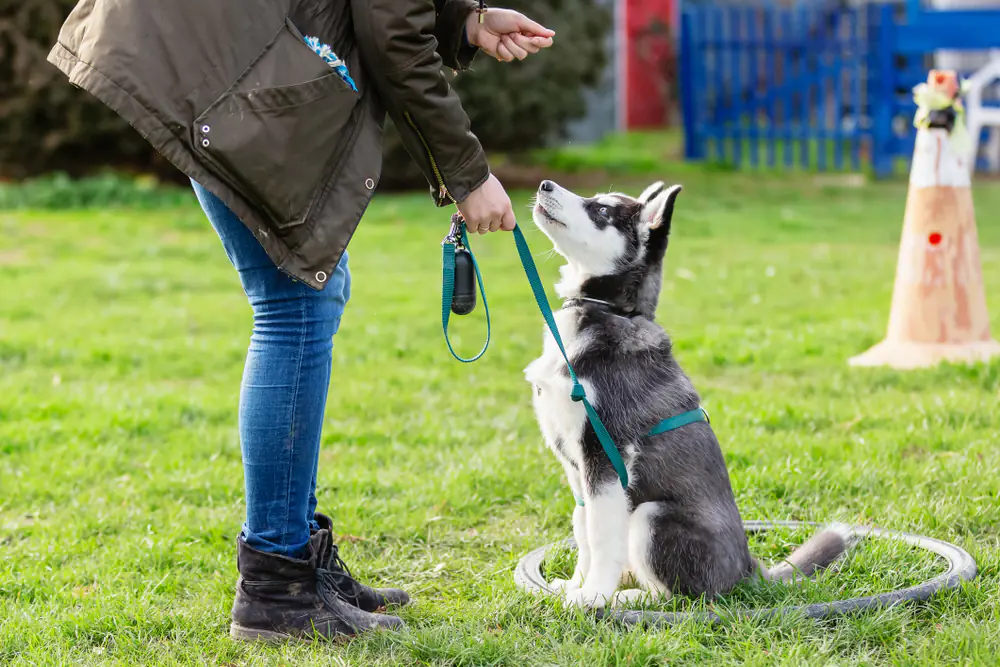
Training should help the puppy function safely and comfortably in human life. The American Veterinary Society of Animal Behavior recommends reward-based methods for all dog training. This means teaching the puppy what you would like them to do and reinforcing that behaviour with something they value, such as food, play, access to an activity or social interaction. Reward-based training does not mean having no rules. It means teaching rules without relying on fear, pain or intimidation.
What is puppy socialisation?
Socialisation is the process through which a puppy learns how to respond to people, dogs and other animals.
Habituation is the closely related process of becoming comfortable with non-social parts of everyday life, including:
- traffic
- household appliances
- bicycles
- wheelchairs
- veterinary equipment
- different surfaces
- unfamiliar places
- grooming
- travelling in a car
- everyday sounds and smells
In general conversation, both processes are usually grouped together under the word “socialisation”. The purpose is not to make a puppy interact with everything.
A well-socialised puppy does not need to greet every person, play with every dog or investigate every object. They need to learn that the presence of these things is manageable and does not automatically signal danger. Sometimes the most useful socialisation experience is simply watching the world from a safe distance.
Socialisation is emotional learning
This is the key difference.
Training often asks:
What behaviour should the puppy perform?
Socialisation asks:
How does the puppy feel in this situation?
For example, you can train a puppy to sit while a cyclist passes. But if the puppy is frozen, refusing food and trying to escape, the sit does not mean they feel safe. The behaviour may look tidy while the emotional experience is going badly.
Good socialisation therefore requires attention to body language. Signs that a puppy may be worried or overwhelmed include:
- freezing
- crouching
- hiding
- trying to move away
- repeatedly turning their head away
- refusing food they would normally take
- excessive panting when it is not hot
- frantic barking or pulling
- difficulty calming down afterwards
If the puppy is becoming frightened, increase the distance, reduce the intensity or end the experience. Exposure alone is not socialisation. A frightening exposure may teach the opposite lesson from the one you intended.
The sensitive period matters
The first months of life are particularly important because young puppies are learning what belongs to normal, everyday life.
The American Veterinary Society of Animal Behavior describes the first three months as the primary period for puppy socialisation. Dogs Trust refers more broadly to the first four months as a vital socialisation window.
The exact timing varies between individual puppies, but the principle is the same: early experiences have a strong influence on later behaviour. This does not mean that learning stops at twelve or fourteen weeks. Puppies, adolescents and adult dogs continue to learn throughout life. However, unfamiliar experiences may become more difficult as natural caution develops. Later learning may therefore require more time, greater distance and a more carefully managed plan.
Why training cannot replace socialisation
A dog can be highly trained and still struggle emotionally.
They may:
- perform cues at home but panic in busy environments
- walk beautifully until another dog appears
- remain in a sit while showing clear signs of fear
- respond to commands but avoid unfamiliar people
- complete obedience exercises while finding ordinary life difficult
Training can help manage these situations, but it does not automatically change the underlying emotion. Repeatedly asking a frightened puppy to sit does not necessarily make the trigger less frightening. Sometimes it merely makes the fear look more organised.
Why socialisation cannot replace training
The reverse is also true. A confident, curious puppy may still:
- pull on the lead
- jump at visitors
- steal food
- chase wildlife
- ignore recall
- struggle to settle
- bite during play
- become frustrated when prevented from reaching something
Confidence is valuable, but it is not the same as self-control or communication. Training gives owners practical ways to guide the puppy and helps the puppy understand what works in different situations.
Where training and socialisation overlap
In real life, training and socialisation often happen together. For example:
Meeting new people
Socialisation goal:
The puppy learns that people of different ages, appearances and movements are safe or neutral.
Training goal:
The puppy learns to remain on the floor, return attention to the owner or move away calmly instead of jumping.
Seeing other dogs
Socialisation goal:
The puppy learns that the presence of another dog does not always mean danger or compulsory play.
Training goal:
The puppy learns to walk past, check in with the owner and respond to a recall or disengagement cue.
Visiting the vet
Socialisation and habituation goal:
The puppy develops positive associations with the building, smells, people, equipment and handling.
Training goal:
The puppy learns to stand on a mat, allow gentle examination and remain engaged with the owner.
Hearing traffic
Habituation goal:
The puppy learns that vehicles, engines and movement are part of ordinary life.
Training goal:
The puppy learns to walk safely, pause at kerbs and maintain contact with the owner.
This is why the best puppy education does not divide life into isolated categories. It combines emotional safety with practical learning.
Do puppy classes help?
A well-run puppy class can support both training and socialisation.
A 2013 study by Kutsumi and colleagues examined 142 dogs with different histories of puppy classes, informal puppy parties, adult classes or no formal classes. Dogs from the puppy-class group showed more positive responses to strangers than dogs from some of the comparison groups. Dogs that had attended puppy or adult classes also performed better on certain command-response measures. However, the study did not find significant differences between the groups in the C-BARQ behavioural questionnaire. That nuance matters.
Puppy classes can be helpful, but the label on the door is not a quality guarantee.
What should a good puppy class look like?
A good class should:
- use reward-based methods
- keep group sizes manageable
- provide enough space between puppies
- prevent uncontrolled free-for-all play
- teach owners to read body language
- allow shy puppies to observe from a distance
- include calm handling and settling
- teach practical life skills
- avoid forcing interactions
- explain how to practise safely at home
A puppy class should not be an hour of chaotic wrestling followed by three minutes of sit. Play can be useful, but it must be matched carefully and interrupted when necessary. Some puppies enjoy direct play. Others learn more by calmly observing dogs without being approached.
Socialisation is not the same as dog-to-dog play
Many owners hear “socialisation” and assume their puppy needs to play with as many dogs as possible. They do not.
A puppy needs to learn a range of appropriate responses around dogs, including:
- observing
- walking past
- disengaging
- approaching calmly
- moving away
- playing appropriately
- stopping when the other dog needs space
Neutrality is an important social skill. A dog who can pass another dog without pulling, barking or demanding an introduction may be better socially prepared than one who believes every dog is an invitation to launch themselves across the pavement.
Avoid overwhelming the puppy
The aim is not to collect the largest possible number of experiences before a deadline.
Quality matters more than quantity.
A short visit to a quiet café, where the puppy can watch people from a comfortable distance, may be more useful than an hour in a crowded town centre.
A calm meeting with one socially skilled adult dog may be more valuable than being released into a group of excited puppies.
A five-minute handling exercise with frequent rewards may teach more than restraining the puppy until they stop struggling.
Do not confuse exhaustion with successful socialisation.
Common mistakes
Forcing contact
Do not push a puppy towards a person, dog or object they are trying to avoid. Choice and distance help create confidence.
Allowing every person to touch the puppy
A puppy can learn about people without being handled by all of them. Constant touching may be overwhelming.
Treating fear as disobedience
A puppy who cannot respond in a difficult environment may be frightened or overstimulated, not stubborn.
Using punishment
Punishment may suppress visible behaviour without improving the underlying emotional response. It can also create negative associations with the trigger, the environment or the owner.
Moving too quickly
If the puppy cannot eat, explore or recover, the situation is probably too difficult.
Forgetting rest
Young puppies need considerable sleep. An overtired puppy may become bitey, frantic, noisy or unable to concentrate.
A simple way to combine both
You do not need a military timetable or a spreadsheet containing forty-seven daily exposures. Try combining one small socialisation experience with one simple training skill.
For example:
- watch traffic from a distance and reward calm check-ins
- visit a quiet café and practise settling on a mat
- observe children playing and reward relaxed behaviour
- meet a calm dog and practise returning when called
- visit the veterinary reception and practise gentle handling
- walk on a new surface and reinforce following you
- hear a household sound quietly while eating or playing
Keep sessions short and stop while the puppy is still coping well. The goal is not to tire them out. The goal is to help them learn.
When to seek professional help
Speak to your vet or a suitably qualified behaviour professional if your puppy:
- regularly freezes or tries to escape
- reacts aggressively through fear
- cannot recover after new experiences
- is increasingly worried by people or dogs
- shows extreme distress when left alone
- is too frightened to eat or explore outside
- suddenly changes behaviour
Early support is not an admission of failure. Waiting until the problem becomes larger is rarely a prize-winning strategy.
More support for your puppy’s first months
My book, The Complete Puppy Care Guide: Raising a Happy, Healthy Dog, covers puppy development, socialisation, training, feeding and the practical reality of bringing a puppy home.
You can buy The Complete Puppy Care Guide on Amazon.
Our Puppy Starter Bundle brings together three 400 g packs of freshly cooked food for weaning and early growth, a printed copy of the guide and a one-hour consultation.
The consultation can help with feeding, settling in, early routines and the questions that appear once the puppy has arrived and every internet expert has offered a different answer.
Final thoughts
Socialisation and training do different jobs, but they work best together.
Socialisation helps a puppy learn that the world is safe and manageable.
Training gives them practical skills for moving through that world.
A confident puppy without guidance can become difficult to manage. A highly trained puppy who feels unsafe may still struggle with everyday life.
The goal is not a dog who performs perfectly.
It is a dog who understands what to do and feels able to cope.
Sources and further reading
- American Veterinary Society of Animal Behavior, Position Statement on Puppy Socialization
- American Veterinary Society of Animal Behavior, Position Statement on Humane Dog Training
- Kutsumi A, Nagasawa M, Ohta M and Ohtani N, Importance of Puppy Training for Future Behavior of the Dog
- McEvoy V et al., Canine Socialisation: A Narrative Systematic Review
- Dogs Trust, Introducing Your Puppy to the World Around Them
- Dogs Trust, Puppy Training 101: What to Do, When and Why
- Dogs Trust, Training Techniques
Newsletter
Like our articles? Wanna more? Please subscribe newsletter
